
Lesson 05: Arithmetic — Adding and Subtracting
Part 1: The 6502 CPU · Estimated time: 45 minutes Prerequisites: Lesson 04 (registers, load/store, immediate & zero-page addressing) You will learn:
ADCandSBC; the carry flag; theCLC-before-add andSEC-before-subtract rules;INC/DEC/INX/DEX; 8-bit wraparound; and how carry chains bytes into 16-bit math You will build: A "calculator" ROM that adds and subtracts two numbers and paints each result as a colored zone — plus a 16-bit addition you can inspect in the debugger
Introduction
In Lesson 04 your registers only carried bytes around — load here, store there. Now they start to compute. This is the first lesson where the accumulator earns its name: the Accumulator is the one register that can do arithmetic, and almost every number a game tracks — a score, a position, a countdown, a velocity — is maintained with the two instructions you'll meet here: ADC (add with carry) and SBC (subtract with borrow).
The 6502 only does 8-bit math, so every result is implicitly taken mod 256: $FF + 1 wraps back to $00, exactly like (a + b) & 0xFF in TypeScript. That "lost" overflow isn't really lost, though — it's captured in the carry flag, a single bit the CPU sets when an addition spills past 255 (or a subtraction needs to borrow). Carry is the hinge this whole lesson turns on: it's both the thing you must initialize correctly before every add or subtract, and the thing that lets you stitch 8-bit operations together into 16-bit (and bigger) numbers.
The companion program 05-arithmetic.asm is a tiny calculator. It loads two numbers, computes their sum with ADC and their difference with SBC, and paints four colored bands so you can literally see each value. It then performs a 16-bit addition and tucks the two-byte result into RAM for you to find in the debugger.
TypeScript Equivalent
On the 6502 every byte is a Uint8, so arithmetic always wraps at 256 — and the bit that "fell off the top" is the carry flag:
// 8-bit math always wraps — just like masking to a byte:
const sum  = (0x30 + 0x12) & 0xFF;   // 0x42  — fits, no carry
const wrap = (0xFF + 0x01) & 0xFF;   // 0x00  — overflowed! carry = 1

// The carry flag is literally "did it exceed 255?":
const carry = (0xFF + 0x01) > 0xFF ? 1 : 0;  // 1

// 16-bit addition out of two 8-bit adds — carry chains the halves,
// exactly like ADC the low byte, then ADC the high byte:
function add16(a: number, b: number): number {
  const lo = (a & 0xFF) + (b & 0xFF);
  const loByte = lo & 0xFF;
  const carry  = lo > 0xFF ? 1 : 0;        // <- the 6502's carry flag
  const hi = ((a >> 8) & 0xFF) + ((b >> 8) & 0xFF) + carry;
  return ((hi & 0xFF) << 8) | loByte;
}The catch the 6502 adds: there's no bare "add." Every add is add-with-carry, so you are responsible for setting carry to a known state first (CLC for a fresh add, SEC for a fresh subtract).
Theory
Section 1: ADC — Add With Carry
The 6502 has exactly one addition instruction, and it always adds three things:
A = A + operand + carryThat + carry is not optional — there is no plain "add." So before a standalone addition you must clear the carry with CLC (CLear Carry), guaranteeing the stray third term is 0:
    LDA NumA        ; A = $30
    CLC             ; carry = 0   <-- ALWAYS do this before a fresh ADC
    ADC NumB        ; A = $30 + $12 + 0 = $42
STA Sum ; Sum = $42Forget the CLC and a leftover carry from some earlier operation silently adds an extra 1 — one of the most common 6502 bugs there is. The mnemonic to burn in: "Clear before you add."
If the true result exceeds $FF, A keeps only the low 8 bits and the carry flag is set to 1 to record the overflow. That's not an error — it's the raw material for 16-bit math (Section 4).
Section 2: SBC — Subtract With Borrow
Subtraction mirrors addition, but the carry flag plays the role of an inverted borrow:
A = A - operand - (1 - carry)So carry set (1) means "no borrow." To start a clean subtraction you set the carry first with SEC (SEt Carry):
    LDA NumA        ; A = $30
    SEC             ; carry = 1  (= "no borrow")   <-- ALWAYS before a fresh SBC
    SBC NumB        ; A = $30 - $12 - 0 = $1E
STA Diff ; Diff = $1EThe pairing to memorize: CLC before ADC, SEC before SBC. They feel backwards at first (clear to add, set to subtract), but the logic is consistent: in both cases you're zeroing out the extra term so the very first operation is "clean."
After SBC, the carry tells you whether a borrow happened: carry still set ⇒ no borrow (the minuend was ≥ the subtrahend); carry clear ⇒ it borrowed (the result went negative and wrapped). You'll use that to compare numbers in Lesson 06.
PAL Note
Arithmetic is pure CPU — the 6507 behaves identically on NTSC and PAL machines. The ADC/SBC/carry rules in this lesson are timing- and region-independent. (The only place the 2600 changes math behavior is decimal mode, SED, which we deliberately avoid until Lesson 40 — +clean_start runs CLD to keep us in plain binary.)
Section 3: Wraparound, and the Quick Counters
Because results are 8-bit, they wrap silently:
| Operation | True value | Stored in A | Carry after |
|---|---|---|---|
$30 + $12 | 66 ($42) | $42 | 0 (fit) |
$F0 + $25 | 277 ($115) | $15 | 1 (overflow) |
$30 - $12 | 30 ($1E) | $1E | 1 (no borrow) |
$10 - $20 | −16 | $F0 | 0 (borrowed) |
For the extremely common "just add or subtract one" case, the 6502 gives you single-instruction shortcuts that don't touch carry and don't go through A at all:
| Instruction | Effect | Works on |
|---|---|---|
INC addr / DEC addr | memory byte ± 1 | a RAM/zero-page location |
INX / DEX | X ± 1 | the X register |
INY / DEY | Y ± 1 | the Y register |
You've already used DEX as a loop counter in every kernel so far. INC/DEC are perfect for things like a frame counter or a countdown timer (Exercise 2), since they update a variable in place without disturbing the accumulator.
TypeScript Equivalent
let frame: number = ram[0x84];
frame = (frame + 1) & 0xFF;   // INC $84  — wraps at 256
ram[0x84] = frame;

let x: number = 5;
x = (x - 1) & 0xFF;           // DEX
// INC/DEC/INX/DEX leave the carry flag untouched — unlike ADC/SBC.Section 4: Carry Is the Glue — 16-Bit Addition
A single byte can't count past 255, but scores and positions routinely need more. The fix is to spread a number across two bytes (a low byte and a high byte) and let the carry flag carry the overflow from the low add into the high add — exactly like carrying a digit in long addition:
    ; 16-bit:  $00F0 + $0025  =  $0115
    LDA #$F0        ; low byte
    CLC             ; clear carry before the FIRST add only
    ADC #$25        ; $F0 + $25 = $115 -> A = $15, carry = 1
    STA SumLo       ; SumLo = $15
    LDA #$00        ; high byte
    ADC #$00        ; $00 + $00 + carry(1) = $01   <-- NO clc here!
STA SumHi ; SumHi = $01 -> result $0115The pattern is the whole point: CLC once at the very start, then let each subsequent ADC inherit the carry from the one before it. The low-byte add produced a carry of 1; the high-byte add folds it in automatically. Subtraction chains the same way with SEC once, then SBC, SBC, … This generalizes to 24-bit, 32-bit, or any width — it's how the 8-bit 6502 handled "big" numbers throughout the 8-bit era.
The Code
Building This Lesson
acme -f plain -o build/lesson05.bin \
  lessons/part1-6502-cpu/05-arithmetic/05-arithmetic.asm
stella build/lesson05.binFull Source
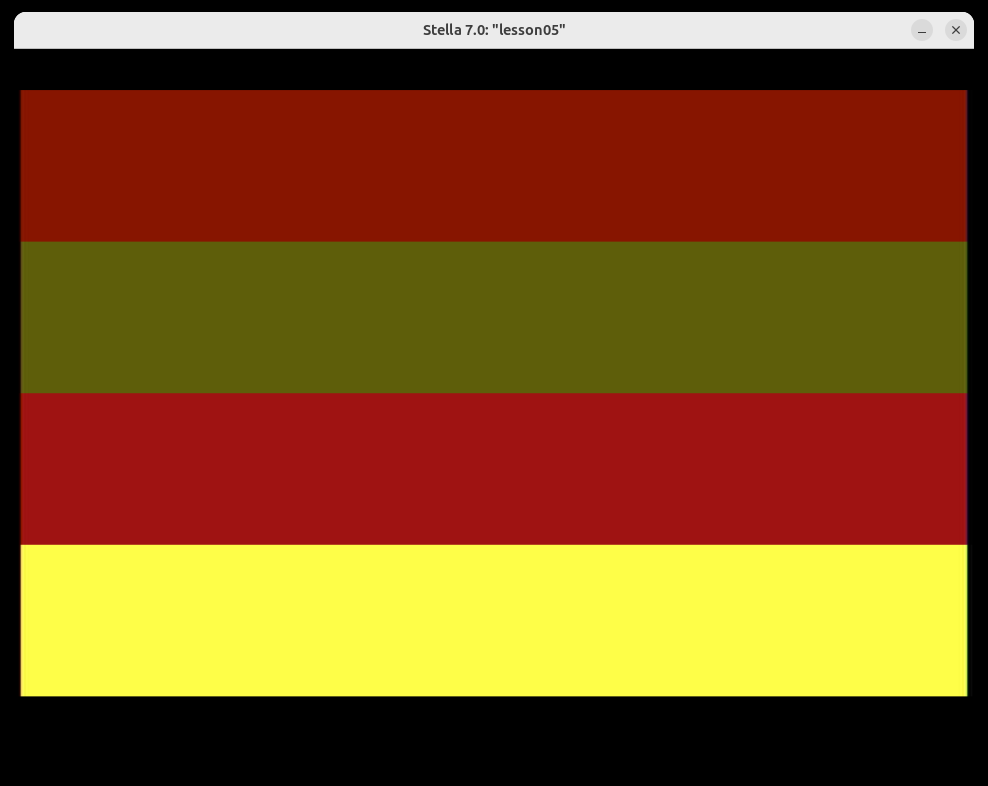
The program computes a sum and a difference, performs a 16-bit add, then paints four 48-line zones — one per single-byte value — so each arithmetic result is visible on screen.
; =============================================================================
; LESSON 05: Arithmetic — Adding and Subtracting
; =============================================================================
    !cpu 6502
    !source "include/vcs.asm"
    !source "include/macro.asm"

; --- RAM VARIABLES (RIOT RAM, $80-$FF) ---
NumA        = $80    ; first operand
NumB        = $81    ; second operand
Sum         = $82    ; NumA + NumB  (8-bit, wraps mod 256)
Diff        = $83    ; NumA - NumB  (8-bit, borrows mod 256)
SumLo       = $84    ; low  byte of the 16-bit sum
SumHi       = $85    ; high byte of the 16-bit sum

    * = $F000

Reset:
    +clean_start            ; zero RAM/TIA, set stack — and CLD (binary math)

    ; --- Set up the two operands ---
    LDA #$30            ; A = $30 (48)
    STA NumA
    LDA #$12            ; A = $12 (18)
    STA NumB

    ; --- ADD: Sum = NumA + NumB ---
    LDA NumA            ; A = $30
    CLC                 ; carry = 0   (essential before ADC!)
    ADC NumB            ; A = $30 + $12 + 0 = $42
    STA Sum             ; Sum = $42

    ; --- SUBTRACT: Diff = NumA - NumB ---
    LDA NumA            ; A = $30
    SEC                 ; carry = 1 (= "no borrow"; essential before SBC!)
    SBC NumB            ; A = $30 - $12 - 0 = $1E
    STA Diff            ; Diff = $1E

    ; --- 16-BIT ADD: SumHi:SumLo = $00F0 + $0025 = $0115 ---
    LDA #$F0
    CLC                 ; clear carry before the low-byte add
    ADC #$25            ; $F0 + $25 = $115 -> A = $15, carry = 1
    STA SumLo           ; SumLo = $15
    LDA #$00
    ADC #$00            ; $00 + $00 + carry(1) = $01   (no CLC here!)
    STA SumHi           ; SumHi = $01  ->  full result $0115

StartFrame:
    +vsync                  ; new frame

    LDA #$02
    STA VBLANK
    +set_timer 43
    +wait_timer
    LDA #$00
    STA VBLANK

    ; --- KERNEL: four 48-line zones, one per computed value ---
    LDA NumA            ; Zone 1: NumA ($30)
    STA COLUBK
    LDX #48
-   STA WSYNC
    DEX
    BNE -

    LDA NumB            ; Zone 2: NumB ($12)
    STA COLUBK
    LDX #48
-   STA WSYNC
    DEX
    BNE -

    LDA Sum             ; Zone 3: Sum ($42)
    STA COLUBK
    LDX #48
-   STA WSYNC
    DEX
    BNE -

    LDA Diff            ; Zone 4: Diff ($1E)
    STA COLUBK
    LDX #48
-   STA WSYNC
    DEX
    BNE -

    LDA #$02
    STA VBLANK
    +set_timer 35
    +wait_timer

    JMP StartFrame

; --- VECTORS ---
    * = $FFFA
    !word Reset     ; NMI
    !word Reset     ; RESET
!word Reset ; IRQThe complete, fully-commented source — including the extended teaching comments — lives in
lessons/part1-6502-cpu/05-arithmetic/05-arithmetic.asm.
Code Walkthrough
The two operands
    LDA #$30
    STA NumA            ; NumA = $30 (48)
    LDA #$12
STA NumB ; NumB = $12 (18)Nothing new here — straight from Lesson 04. These are the inputs our calculator will add and subtract.
Add (CLC + ADC) and subtract (SEC + SBC)
    LDA NumA
    CLC                 ; clear before add
    ADC NumB            ; $30 + $12 = $42
    STA Sum

    LDA NumA
    SEC                 ; set before subtract
    SBC NumB            ; $30 - $12 = $1E
STA DiffThis is the heart of the lesson. Notice each operation reloads A first (the accumulator is the only place math happens), prepares the carry (CLC/SEC), runs the operation, then stores the result to RAM. Load → compute → store, just like Lesson 04, but now with a real computation in the middle.
Chaining carry for 16-bit
    LDA #$F0
    CLC
    ADC #$25            ; low half overflows: A=$15, carry=1
    STA SumLo
    LDA #$00
    ADC #$00            ; carry folds into the high half: A=$01
STA SumHiSumLo/SumHi end up holding $15/$01 — the little-endian halves of $0115 (277). The only CLC is before the first add; the second ADC deliberately keeps the carry.
The kernel — four zones
Each 48-line zone reads one computed byte back from RAM and writes it to COLUBK, so the screen becomes a bar chart of your arithmetic. 4 × 48 = 192 visible scanlines, the same total as Lesson 04's three 64-line zones.
What You Should See
When you run this ROM in Stella, the screen splits into four horizontal bands, top to bottom: NumA ($30), NumB ($12), their sum $42, and their difference $1E. Because each value is fed straight into the background-color register, the colors are the numbers — change the operands and the bands shift accordingly.
Now open the debugger (backtick `) and read the RAM view:
$80=$30(NumA),$81=$12(NumB)$82=$42(Sum =$30 + $12)$83=$1E(Diff =$30 - $12)$84/$85=$15/$01— the low/high bytes of the 16-bit sum$0115
Try stepping through the CLC/ADC and SEC/SBC instructions and watch the C flag in the status display flip — that single bit is the star of this lesson.
Exercises
Exercise 1: Add Two 16-Bit Numbers
Challenge: Add $01F0 and $0220 (result $0410) using two-byte arithmetic, then display both result bytes as colored zones to prove the carry chained correctly.
Hints:
- Store each number as two bytes: a low byte and a high byte.
CLConce,ADCthe low bytes, store the low result — the carry is now set if the low add overflowed.- Do not
CLCagain.ADCthe high bytes; the carry from step 2 folds in automatically.
Expected Result: Two colored bands for the high ($04) and low ($10) result bytes. In the debugger, $84/$85 hold $10/$04 — i.e. $0410.
Solution: See exercise-01-solution.asm
Exercise 2: A Countdown Timer Variable
Challenge: Keep a one-byte timer in RAM that counts down by one every frame, and reloads to its starting value when it reaches zero — looping forever. Show the timer as the background color so you can watch it ramp and reset.
Hints:
- Use
DECon the timer's RAM address once per frame — it's a single instruction and leaves carry alone. DECsets the zero flag when the result is0; useBNEto skip the reload until then.- Put the tick in the VBLANK "game logic" gap, before the kernel.
Expected Result: The whole screen smoothly cycles through colors as the timer counts down, then jumps back to the start color when it hits zero — a repeating ramp.
Solution: See exercise-02-solution.asm
Exercise 3: Detect Overflow (Stretch Goal)
Challenge: Add two bytes and detect whether the sum overflowed past $FF. Paint the screen green when it fits and red when it overflows — decided purely by the carry flag.
Hints:
- After
CLC/ADC, the carry is your unsigned-overflow signal:1means the true sum was > 255. BCC(Branch if Carry Clear) branches when the result fit; otherwise it overflowed.- Try operands like
$D0 + $50(overflows) versus$30 + $50(fits) to see both colors.
Expected Result: With overflowing operands the screen is red; with fitting operands it's green. The debugger shows the wrapped sum at $80 and a 0/1 overflow flag at $81.
Solution: See exercise-03-solution.asm
Key Takeaways
- ✅ The accumulator (
A) is the only register that does arithmetic — load into A, compute, store back out - ✅ There's no plain add/subtract: it's always
ADC/SBC, so you must prepare the carry first —CLCbeforeADC,SECbeforeSBC - ✅ On the 6502 a set carry means "no borrow" for subtraction (the carry is an inverted borrow)
- ✅ 8-bit math wraps mod 256; the bit that overflows is captured in the carry flag, not lost
- ✅ Carry is the glue for multi-byte math:
CLC/SEConce, then let eachADC/SBCinherit the carry to build 16-bit (or larger) values - ✅
INC/DEC/INX/DEX/INY/DEYadd or subtract one without touching carry — ideal for counters and timers
What's Next
You've seen the carry flag set and cleared as a side effect of arithmetic — but it's only one of several status flags the CPU keeps. In Lesson 06: Flags and Comparisons, you'll meet the zero, negative, and overflow flags too, learn the CMP/CPX/CPY instructions, and turn those flags into real decisions — the groundwork for branches and loops in Lesson 07.