
Lesson 06: Flags and Comparisons — How the CPU Decides
Part 1: The 6502 CPU · Estimated time: 45 minutes Prerequisites: Lesson 05 (
ADC/SBC, the carry flag,SEC/CLC) You will learn: the processor status register (P); the Z, N, C, and V flags; theCMP/CPX/CPYinstructions; how comparison maps to<,==, and>=; and how flags become decisions You will build: a "comparison" ROM that runs threeCMPs, captures the resulting flags into RAM for the debugger, and paints a green/red truth-table on screen
Introduction
Every program that does anything interesting has to decide: is the score high enough? did the player hit the wall? has the timer run out? In Lesson 05 you saw the carry flag appear as a side effect of arithmetic. This lesson zooms out to the full set of one-bit answers the CPU keeps on hand — the status flags — and introduces the instructions whose entire job is to set those flags so you can branch on them.
The 6502 stores these flags together in a single 8-bit register called the processor status register, usually written P. You never load or store P directly in day-to-day code; instead, almost every instruction updates some of its bits as a by-product, and the branch instructions you'll meet in Lesson 07 read them. Flags are the invisible wire connecting "do some math" to "now act on the result."
The star instruction here is CMP (CoMPare). It answers "how does A relate to this value?" — less than, equal, or greater — and it does so by performing a subtraction it immediately throws away, keeping only the flags. The companion program 06-flags-and-comparisons.asm runs three comparisons, records the Z/C/N flags of the first one into RAM so you can inspect them in the debugger, and turns each comparison's outcome into an on-screen color: green when A >= B, red when A < B.
TypeScript Equivalent
In TypeScript the comparison operators return a boolean. On the 6502 a comparison instead sets flags, and you read those flags afterward:
// TypeScript hands you a boolean directly:
const equal    = (a === b);
const aIsLess  = (a < b);     // unsigned
const aGeOrEq  = (a >= b);

// The 6502 way: CMP performs (a - b), discards the result, and leaves:
//   Z = (a === b)            -> "were they equal?"
//   C = (a >= b)  unsigned   -> "no borrow happened"
//   N = bit 7 of (a - b)     -> sign of the difference
function cmp(a: number, b: number) {
  const diff = (a - b) & 0xFF;     // the subtraction CMP throws away
  return {
    Z: a === b ? 1 : 0,
    C: a >= b  ? 1 : 0,            // unsigned >=
    N: (diff & 0x80) ? 1 : 0,
  };
}The key mental shift: a 6502 comparison doesn't give you a yes/no — it leaves flags behind that the next branch instruction reads.
Theory
Section 1: The Processor Status Register (P)
The 6502 keeps its flags packed into one 8-bit register. Seven of the eight bits are used:
| Bit | 7 | 6 | 5 | 4 | 3 | 2 | 1 | 0 |
|---|---|---|---|---|---|---|---|---|
| Flag | N | V | – | B | D | I | Z | C |
| Name | Negative | oVerflow | (unused) | Break | Decimal | Interrupt | Zero | Carry |
For Part 1 you care about four of them:
| Flag | Set when… | The question it answers |
|---|---|---|
| Z (Zero) | the last result was $00 | "was it zero / were they equal?" |
| N (Negative) | bit 7 of the last result is 1 | "is it negative (as a signed byte)?" |
| C (Carry) | an add overflowed, or a compare/subtract didn't borrow | "unsigned: was it ≥?" |
| V (oVerflow) | a signed add/subtract crossed the ±128 boundary | "did signed math overflow?" |
You already met D (decimal) — +clean_start runs CLD to keep it off — and I/B relate to interrupts, which the 6507 in the 2600 never uses. The two you'll lean on most this lesson are Z and C.
PAL Note
Flags and comparisons are pure CPU behavior — the 6507 sets N, V, Z, and C identically on NTSC and PAL machines. Nothing in this lesson is timing- or region-dependent. (The only flag with region-flavored history is D, decimal mode, which we still avoid until Lesson 40.)
Section 2: Flags Are a Side Effect of (Almost) Everything
Most instructions silently update Z and N based on the value they produce. An LDA that loads $00 sets Z; an LDA that loads $80–$FF sets N (because bit 7 is on). This is why you can often skip an explicit compare:
    LDA Lives       ; loading also updates Z and N…
BEQ GameOver ; …so you can branch on "Lives == 0" immediatelyKnowing which instructions touch which flags is part of learning the 6502, but the rule of thumb is simple: anything that produces a value in a register usually updates Z and N; only ADC, SBC, and the compares touch C; only ADC/SBC touch V.
Section 3: CMP — Compare by Subtracting and Throwing It Away
CMP is the workhorse. Mechanically it computes A - operand exactly like SBC with carry pre-set, but it does not store the result anywhere — A is left untouched. All it leaves behind are the flags:
CMP operand ≈ (A - operand), keep only Z, C, N — A is unchangedThat gives you three comparisons for the price of one instruction:
| You want | Flag to test | Branch (Lesson 07) |
|---|---|---|
A == operand | Z = 1 | BEQ |
A != operand | Z = 0 | BNE |
A >= operand (unsigned) | C = 1 | BCS |
A < operand (unsigned) | C = 0 | BCC |
The carry rule is the same "set carry means no borrow" idea from Lesson 05: if A is big enough that the subtraction doesn't borrow, carry stays set — which is exactly A >= operand. Memorize this pair:
BEQ/BNEread Z → equalityBCS/BCCread C → unsigned ordering (>=/<)
TypeScript Equivalent
// CMP sets the flags; the branch reads them. Written out longhand:
function compareAndAct(a: number, b: number) {
  // --- CMP #b ---
  const diff = (a - b) & 0xFF;
  const Z = (a === b);
  const C = (a >= b);          // unsigned >=
  // --- the branches you'd use next lesson ---
  if (Z)  { /* BEQ: equal      */ }
  if (!Z) { /* BNE: not equal  */ }
  if (C)  { /* BCS: a >= b      */ }
  if (!C) { /* BCC: a <  b      */ }
}Section 4: CPX and CPY — Comparing the Index Registers
CMP only compares against the accumulator. The X and Y registers get their own compare instructions, CPX and CPY, which work identically but against X or Y:
    LDX #10
CPX #10 ; X - 10 -> Z=1 (equal), C=1 (X >= 10)These are how you test loop counters. You've been ending loops with DEX / BNE — that works because DEX updates Z. But when you need to compare a counter to a specific non-zero limit, CPX #limit / CPY #limit is the tool. A very common pattern counts up to a limit:
    LDX #0
Loop:
    ; … do something with X …
    INX
    CPX #8          ; reached 8 yet?
BNE Loop ; no -> keep going (loops for X = 0..7)Section 5: Signed vs Unsigned — Why Both C and N Exist
CMP gives you an honest unsigned comparison through the carry flag. But bytes are sometimes meant as signed values ($FF = −1, $80 = −128). For signed comparisons the carry alone isn't enough — you'd combine N and V. We won't write signed comparisons until later, but it's worth knowing why there are two "sign-ish" flags:
- C answers the unsigned question ("is the bit pattern larger?")
- N and V together answer the signed question ("is the number larger?")
For now, every comparison in this lesson is unsigned, so carry is the ordering flag and N is just along for the ride as "bit 7 of the difference."
The Code
Building This Lesson
acme -f plain -o build/lesson06.bin \
  lessons/part1-6502-cpu/06-flags-and-comparisons/06-flags-and-comparisons.asm
stella build/lesson06.binFull Source
The program runs three comparisons. For the first ($40 vs $40) it snapshots the Z, C, and N flags into RAM so you can read them in the debugger. For all three it converts the carry into a color — green for A >= B, red for A < B — and paints one 64-line zone per comparison.
; =============================================================================
; LESSON 06: Flags and Comparisons — How the CPU Decides
; =============================================================================
    !cpu 6502
    !source "include/vcs.asm"
    !source "include/macro.asm"

; --- Color constants (NTSC) ---
GREEN       = $C8       ; "A >= B" — comparison passed
RED         = $44       ; "A <  B" — comparison failed

; --- RAM VARIABLES (RIOT RAM, $80-$FF) ---
FlagZ       = $80       ; 1 if the first compare was EQUAL      (Z flag)
FlagC       = $81       ; 1 if the first compare had A >= B     (C flag)
FlagN       = $82       ; 1 if (A - B) had bit 7 set            (N flag)
Color1      = $83       ; result color for pair 1 (equal)
Color2      = $84       ; result color for pair 2 (less)
Color3      = $85       ; result color for pair 3 (greater)

    * = $F000

Reset:
    +clean_start            ; zero RAM/TIA, set stack, CLD (binary math)

    ; --- PAIR 1: $40 vs $40 (EQUAL) — capture all three flags into RAM ---
    LDA #$40            ; A = $40
    CMP #$40            ; compare A with $40 (internally A - $40, flags only)

    LDX #$00            ; capture Z (1 = equal)
    BNE +
    LDX #$01
+   STX FlagZ           ; FlagZ = 1

    LDX #$00            ; capture C (1 = A >= operand)
    BCC +
    LDX #$01
+   STX FlagC           ; FlagC = 1

    LDX #$00            ; capture N (1 = bit 7 of A-operand set)
    BPL +
    LDX #$01
+   STX FlagN           ; FlagN = 0

    LDA #$40            ; pick pair 1's color from the carry
    CMP #$40
    LDX #RED
    BCC +
    LDX #GREEN
+   STX Color1          ; equal counts as ">=" -> GREEN

    ; --- PAIR 2: $20 vs $60 (A < B) -> RED ---
    LDA #$20
    CMP #$60            ; borrows -> carry CLEAR
    LDX #RED
    BCC +
    LDX #GREEN
+   STX Color2

    ; --- PAIR 3: $90 vs $30 (A > B) -> GREEN ---
    LDA #$90
    CMP #$30            ; no borrow -> carry SET
    LDX #RED
    BCC +
    LDX #GREEN
+   STX Color3

StartFrame:
    +vsync                  ; new frame

    LDA #$02
    STA VBLANK
    +set_timer 43
    +wait_timer
    LDA #$00
    STA VBLANK

    ; --- KERNEL: three 64-line zones, one per comparison result ---
    LDA Color1          ; Zone 1: equal   -> GREEN
    STA COLUBK
    LDX #64
-   STA WSYNC
    DEX
    BNE -

    LDA Color2          ; Zone 2: less    -> RED
    STA COLUBK
    LDX #64
-   STA WSYNC
    DEX
    BNE -

    LDA Color3          ; Zone 3: greater -> GREEN
    STA COLUBK
    LDX #64
-   STA WSYNC
    DEX
    BNE -

    LDA #$02
    STA VBLANK
    +set_timer 35
    +wait_timer

    JMP StartFrame

; --- VECTORS ---
    * = $FFFA
    !word Reset     ; NMI
    !word Reset     ; RESET
!word Reset ; IRQThe complete, fully-commented source lives in
lessons/part1-6502-cpu/06-flags-and-comparisons/06-flags-and-comparisons.asm.
Code Walkthrough
Comparing, then reading the flags
    LDA #$40
    CMP #$40            ; A - $40 internally; A stays $40, only flags change
    LDX #$00
    BNE +               ; Z clear? skip (values differed)
    LDX #$01            ; Z set -> they were equal
+ STX FlagZCMP does the subtraction $40 - $40 = $00, which sets Z. The result $00 is not stored — A is still $40. We then test the flag with a branch and record a clean 0/1 into RAM. The same pattern repeats for C (using BCC) and N (using BPL).
Anonymous labels
The + after each BNE/BCC/BPL is ACME's forward anonymous label — it means "the next + line." It's perfect for these tiny two-way skips where inventing a unique name would just add noise. You first saw - (backward) labels as loop tops; + is its forward-jumping sibling.
Turning a comparison into a color
    LDA #$20
    CMP #$60            ; $20 < $60 -> borrow -> carry CLEAR
    LDX #RED
    BCC +               ; carry clear (A < B)? keep RED
    LDX #GREEN          ; else A >= B -> GREEN
+ STX Color2This is the comparison idiom you'll use constantly: load, compare, branch on carry, store the chosen value. Pair 2 has A < B, so carry is clear, BCC is taken, and the color stays RED. Pairs 1 and 3 leave carry set, so the branch falls through to GREEN.
The kernel — three zones
Each 64-line zone reads one result color from RAM into COLUBK. 3 × 64 = 192 visible scanlines — the same total you used in Lesson 04. The screen becomes a literal truth-table of the three comparisons.
What You Should See
When you run this ROM in Stella, the screen splits into three horizontal bands: green (pair 1, $40 == $40, so >= holds), red (pair 2, $20 < $60), and green again (pair 3, $90 > $30). The colors are the comparison results — green means the carry was set (A >= B), red means it was clear (A < B).
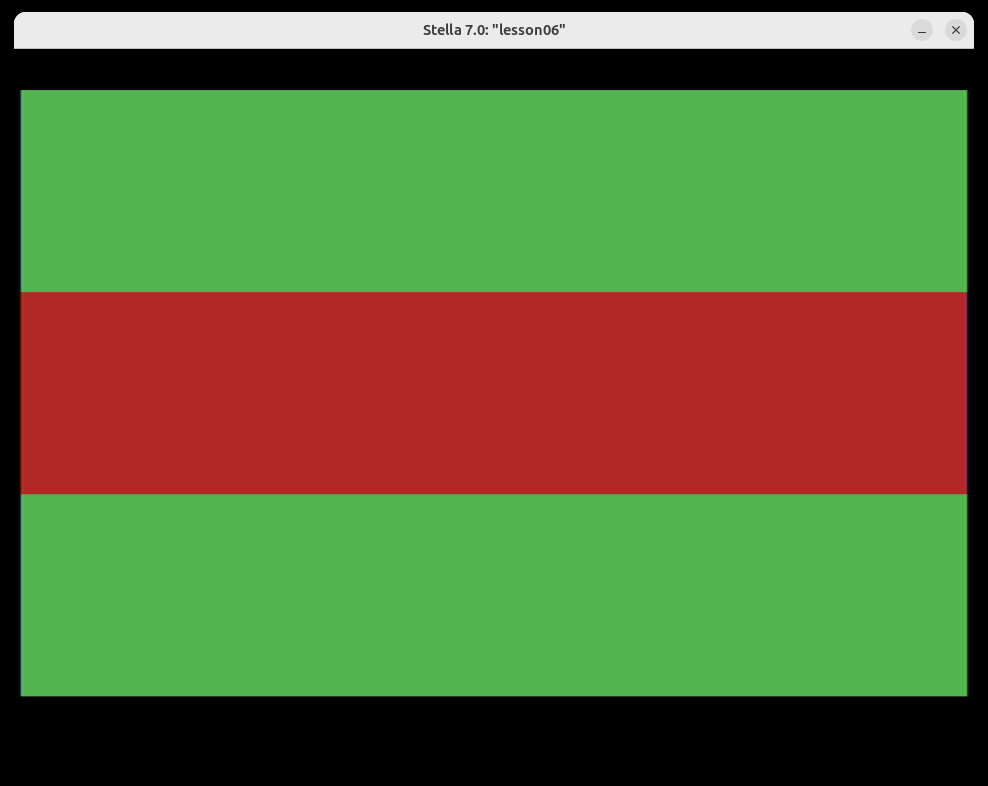
Now open the debugger (backtick `) and read the RAM view for the first comparison's captured flags:
$80=$01— Z was set ($40 == $40, equal)$81=$01— C was set ($40 >= $40)$82=$00— N was clear ($40 - $40 = $00, bit 7 off)$83/$84/$85=$C8/$44/$C8— the three zone colors (green/red/green)
Single-step the three CMP instructions and watch the N, Z, and C indicators in Stella's status display flip. Seeing the flags change as the operands change is the whole point — those bits are what every branch in Lesson 07 will read.
Exercises
Exercise 1: Predict the Flags
Challenge: Before running anything, predict the Z, C, and N flags for A = $50 compared against $50, $80, and $10. Then capture all three flags for each comparison into RAM and check your predictions in the debugger.
Hints:
CMPcomputesA - operandand keeps only the flags — work each subtraction on paper.- Z = "result was
$00"; C = "A >= operand, no borrow"; N = "bit 7 of the difference." - Capture each flag the same way the lesson does: zero a register, branch on the flag, set it to
1.
Expected Result: In the debugger: $50 vs $50 → Z=1 C=1 N=0; $50 vs $80 → Z=0 C=0 N=1; $50 vs $10 → Z=0 C=1 N=0.
Solution: See exercise-01-solution.asm
Exercise 2: Max of Two Values
Challenge: Given two bytes ValA and ValB, compute the larger of the two with a single CMP and a single branch, store it in Max, and paint the whole screen with the winning value.
Hints:
- Load
ValA, thenCMP ValB. Carry set meansValA >= ValB—ValAis already the max. - Use
BCSto keepAwhenValAwins; otherwise fall through andLDA ValB. - This is
if (a < b) a = b;expressed as one compare plus one branch.
Expected Result: With ValA = $30, ValB = $90, the screen takes color $90 and Max ($82) holds $90.
Solution: See exercise-02-solution.asm
Key Takeaways
- ✅ The 6502 keeps its decision bits in the processor status register (P) — you rarely touch it directly; instructions update it and branches read it
- ✅ The four flags that matter in Part 1 are Z (zero/equal), N (negative/bit 7), C (carry/unsigned
>=), and V (signed overflow) - ✅ Most instructions update Z and N as a side effect — you can often branch right after an
LDAwithout a separate compare - ✅
CMPis a throwaway subtraction: it computesA - operand, discards the result, and leaves Z, C, N — leavingAunchanged - ✅ For unsigned comparisons:
BEQ/BNEtest equality via Z;BCS/BCCtest ordering (>=/<) via C - ✅
CPX/CPYdo the same against the X and Y registers — ideal for counting loops up to a limit
What's Next
You now have flags and the comparisons that set them — but so far you've only captured them into RAM. In Lesson 07: Branches and Loops you'll put them to work for real: the full family of branch instructions (BEQ, BNE, BCS, BCC, BMI, BPL), structured loops, and the conditional control flow that turns a list of instructions into an actual program.